Showing posts with label Tracks of My Georgia Ancestors. Show all posts

3/17/20

A Wee Bit Irish


A few years ago I spit in a tube and sent it off to a DNA project on ancestry.com.  What a surprise to find out I am 29% Irish.  As they say in ancestry.com ads, "I had no idea". 

Really, 29% is a wee bit more than 'A Wee Bit Irish', and again to quote the 'Ad'..."I wanted to know more". 

The search began on my ancestry DNA Story with two family names.  Both from my father's maternal line.

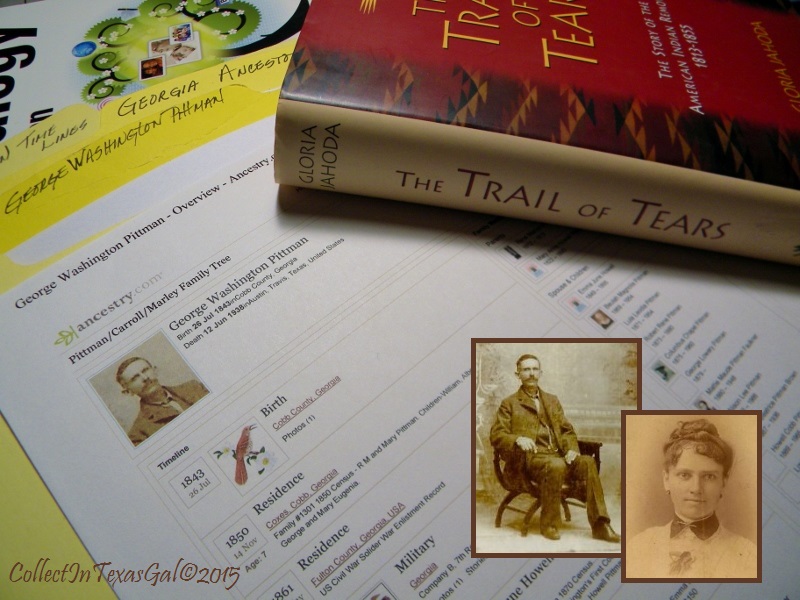
It starts with my Great Grandmother Martha Jane Marley Carroll and her Mother, Mary Josephine Leatherwood Marley.  Neither of the names Carroll or Leatherwood to my ear had a ring of Irish.  As it turns out the Leatherwood line lead through at least five great grandmothers maiden names to reach an Irish descendent.  That's the 'Wee Bit Irish' DNA accounting.

Carroll, which is my father's middle name and the last name of his grandfather Stephen Bennett Carroll, lead to a 'Whole Lot More Irish'.
  Read HERE about my 6th Great Grandfather...born on Saint Patricks Day in Limerick, Ireland.
The Irish say...
May there always be work for your hands to do.
May your purse always hold a coin or two.
May the sun always shine on your windowpane.
May a rainbow be certain to follow each rain.
May God fill your heart with gladness to cheer you.
May the hand of a friend always be near you.
Wannabe Irish/Scottish? 
Just Share the Blessings!
His name was Fleming, and he was a poor Scottish farmer.  One day, while trying to make a living for his family, he heard a cry for help coming from a nearby bog.  He dropped his tools and ran to the bog.  There, mired to his waist in black muck, was a terrified boy, screaming and struggling to free himself.  Farmer Fleming saved the lad from what could have been a slow and terrifying death.
 
The next day, a fancy carriage pulled up to the Scotsman's sparse surroundings.  an elegantly dressed nobleman stepped out and introduced himself as the father of the boy Farmer Fleming had saved.  "I want to repay you," said the nobleman.  "You saved my son's life."
 
No, I can't accept payment for what I did, the Scottish farmer replied waving off the offer.  At that moment, the farmer's own son came to the door of the family hovel.  "Is that your son?" the nobleman asked.  "Yes," the farmer replied proudly.  "I'll make you a deal.  Let me provide him with the level of education my own son will enjoy.  If the lad is anything like his father, he'll no doubt grow to be a man we both will be proud of."  And that he did.
 
Farmer Fleming's son attended the very best schools and in time, graduated from St. Mary's Hospital Medical School in London, and went on to become known throughout the world as the noted Sir Alexander Fleming, the discoverer of Penicillin.
 
Years afterward, the same nobleman's son who was saved from the bog was stricken with pneumonia.  What saved his life this time?  Penicillin.  The name of the nobleman?  Lord Randolph Churchill...His son's name?  Sir Winston Churchill.
Pass it on...Happy Saint Patricks Day!

3/26/19

52 Weeks Challenge-Week 13...Liberty Bond Paid In Full

Back to Family Trees in 2019 with 52 Ancestors in 52 Weeks
Week 13  ~ prompt ~ In The News
~click on pictures to enlarge and read articles~
  Your Family and Country are forever grateful for your sacrifice for our Freedom.
You are remembered in the Pittman Family Tree my 1st cousin 2x removed. 
**Daniel - Cobb County Times August 15, 1918 Memorial Service Held for Daniel W. Pittman
Many Attend Services at Macland on Sunday in Honor of First Cobb County Boy To Die in France.  Last Sunday morning at eleven o'clock, hundreds of Cobb county citizens gathered at the Methodist church at Macland to attend the memorial services I honor of Daniel Weyman Pittman, the first Cobb county boy to be killed in action in France.
    The little church was filled to overflowing when Rev. Frank Jenkins, the pastor, began his memorial address, which pulsated the sympathy for the bereaved and loyal friends to our government in this crisis.  Mr. Watson of Dallas, rendered some special music for the occasion.  Daniel Weyman Pittman was the son of Isaac M. Pittman, one of the best known citizens of that community.  Young Pittman was a graduate of the Seventh District A and M College of Macland, and had many friends throughout that section of the county.
 

3/12/19

52 Ancestors Challenge...Week 11...Zipity-Do-Da Zilpha's Tribe

Back to Family Trees in 2019 with 52 Ancestors in 52 Weeks
Week 11  ~ prompt ~ Large Family
      Like most Colonial American families, my 5x great grandparents had what we call today a 'bunch of kids' who in turn had 'bunches of kids'.  In the process of researching and analyzing the lifestyle of these early ancestors, I've come to a few ideas why kids were 'cheaper by the dozen or more'.
     First, more workers for both farm and home.  Boys to plow and harvest and girls to spin, sew, bake, babysit and everything else.  Secondly...what else was there to do when it was dark-thirty, candles were conserved, lamps were blown out and kids were put to bed when the sun went down. Lastly, there was the tradition of naming children after paternal's and maternal's times two, favorite relatives and famous people.  
     Of their twelve children, daughter number seven appears to be the only child given a really uncommon name.  Their other children  had relatively simple and traditional names like Martha, Grace, Timothy, and Lucy...so how and why Zilpha?
     As I looked down the list, I noticed several of their children had names found in the Bible like John, Sarah, and Mary.  I had never heard of a Zilpha in the Bible, but I gave it a 'Google' and BINGO...EUREKA...ZILPHA!!!
      Zilpha was the handmaid of Leah and the concubine of Jacob.  Her sons Gad and Asher were the founders of two of the twelve tribes of Israel.  It is Hebrew in origin and means dropping or sprinkling.
     Now I know that John and Mary were not of Hebrew descent, and perhaps they could not come up with another girls name so to the Bible they went.  We've all done it, ya know....the closed eyes and stab a finger to a verse and the first name that pops up is the one.  Can you imagine their hesitation?  I'm sure I would have said, "Once more...for heavens sake".

      Zilpha was born January 16, 1762 in Amelia, Virginia.  She was a young girl during the American Revolution.  Her father and brothers were soldiers and Virginia Patriots.  Zilpha was with her mother when the Tories raided their home and threw Mary Polly off the porch leaving her with a broken hip and a cripple for the rest of her life.
      Zilpha's first marriage was to Blanton Nobles from Edgefield County, South Carolina, with one child, a son, Theodore, born to the marriage.  She is named as Zilpha Nobles in her father John's will written and sealed on April 19, 1782 which casts some doubt on the date of her second marriage to Simon Peacock and puts into perspective the following account of Blanton Nobles.
      In 1780, Blanton Nobles, age 18, was listed in the service of Loyalist Colonel John Fisher's Regiment, Orangeburgh Militia, under the command of Captain Joseph Nobles Company.  Captain Nobles was killed in action that same year leaving his son Joshua and nephew (?) Blanton without their leader.  The following year in September 1781, Blanton and Joshua defected from the Loyalists Ninety-Six Brigade/Stevensen's Creek Militia of South Carolina over to the rebels also known as the Sons of Liberty, of which Zilpha's father John and brothers Buckner, John, James and Phillip were active members.
      After the birth of their son Theodore, Blanton disappeared...according to Nobles Family History documentation.  It is thought that he re-invented himself as Beland Nobles and started a new life in Orangeburgh, South Carolina.  Dates are not included here as they are highly speculative and in direct conflict with dates from the Pittman Family history that are historically documented and correct. 
     In summary, it is probable that Zilpha and Blanton were married sometime in 1781 after his defection from from the Loyalist.  The birth and subsequent history of their son Theodore is not documented in Zilpha's  history...unless...he became Barnabas T. Peacock born in 1782.
      Zilpha and Simon Peacock had 10 sons and 4 daughters.  The last child, son Washington born in 1801 would have been just two years old when his mother died at the age of 41.  Simon lived until 1831 and died in Wayne County, North Carolina at the age of  78.  He and Zilpha Pittman Peacock are the Patriarch/Matriarch's of a long and well documented line of Peacock descendants in North and South Carolina. 
     When Zilpha married in 1782 at twenty years of age, I imagine she had thoughts of at least getting a new last name with a different letter of the alphabet other than 'P'.  But, no....it was not to be...she  married Simon Peacock.  Her initials remained the same...ZIP.
     As it turned out Zilpha's parents were prophetic in the naming of their seventh daughter.
Like her namesake, whose sons became the founders of Two Tribes of Israel,
 Zilpha's sons became the founders of Ten Tribes of Peacocks.
Of Zilpha's and Simon's fourteen children two of them
 had names that started with Z...Zadock and Zilpha.
Bible Naming history repeated!!!    
Bless their Zipity-Do-Da Hearts! 

3/7/19

52 Ancestors Challenge...Week 10...Assumed Bachelor Uncle

Back to Family Trees in 2019 with 52 Ancestors in 52 Weeks
Week 10  ~ prompt ~ Bachelor Uncle
The Missing Life of Jeptha
Born in 1787. Died in 1864. That is all. There's not one record of anything inbetween for John and Lucy's fourth son, brother of Ichabod, Marshall and John.  Not a scrap of information that he was even on the roll of the early census when the count was determined by the number of  Free White Males living in a household.

At the time of his death at age 77, Jeptha surely would have been buried near someone in his family even if he had never married or fathered any children.  He was one of nine children....five younger than he, and with many nieces and nephews who as family tradition dictated took care of old uncles.

Gone But Not Forgotten for old Jeptha, did not seem to be written on any tombstone, either.  Instead it seems he was 'Gone and Forgotten' for his name does not appear in any of the cemeteries that were the final resting places of his family.  There are several that bare his family name and Mount Carmel Methodist Church Cemetery where his parents are buried on land donated by his brother Daniel for the church and cemetery.

So for Jeptha, we will have to be satisfied knowing that his early years were lived much like his brothers, and he grew up with the same values and good intentions for living a Christian life with the idea that he too would marry, have children and grandchildren and be buried in a family plot.  Most likely all of that did happen for Jeptha.  However, there is always the possibility that a completely unforeseen turn of events sent him down a different path...at least at the end of his life.  It was, afterall, during the Civil War.

The one bit of information that hints at the possibility of his death being related somehow to the Civil War is the place of his death....Whitfield County, Georgia.  Whitfield was a hotbed of  skirmishes  in 1864 from January through October, and Whitfield organized almost 20 outfits of Infantry, Volunteer and Guard Units.  Even at age 77 Jeptha could have been in one of the Home Guard Units or a Volunteer fighter at the Battle of Buzzards Roost or the Battle of Nickajack Gap.  Perhaps one day, another scrap of information will be found, and the missing life of Jeptha will be found.  Until then...

Rest In Peace, Uncle Jeptha in your virtual cemetery beside your parents at Mount Carmel.

You may be Gone but You are Not Forgotten in Tracks of My Georgia Ancestors...for as I continue to say....

"Every person in your Family Tree is 'Significant In Time' for there is no such thing as a life not meant for the person living it."

Your 4th Great niece from Texas

2/25/19

52 Ancestors Challenge...Week 9...Life and Death At The Courthouse

Back to Family Trees in 2019 with 52 Ancestors in 52 Weeks
Week 9  ~ prompt ~ At The Courthouse
Mordecai Monroe Pittman
 Jackson County Attorney and County Court Judge 1875-1877.
Jackson County Courthouse - Jefferson, Georgia
     A two-story brick building built in 1879.  It was one of the first post-Civil War county courthouses built in Georgia.  It's courtroom has a Cathedral quilt pressed metal coved ceiling and the building is unusual for surviving with little-alteration since it's construction. (photo public domain Wikipedia)

There have been a good many of my Georgia ancestors who spent time 'At The Courthouse'.  Courthouse records have revealed a few standing in front of a judge for sentencing.  Others for filing on property disputes, will and estate petitions, and various Civil Court issues.       Several have been lawyers with political aspirations through the higher courts of Georgia.  For example my 1st Cousin 4x removed the Honorable Daniel Pittman who wrote a scathing article in the Macon Weekly Telegraph concerning the Congressional Resumption Act of 1875.  His Honor, from the Courthouse Bench' ruled on the case of the Fulton County Greenback Party vs the Congressional Resumption Act.  Read more:  Ordinary Court Judge's Greenback Judgement.
     Judge Mordecia Pittman, 2nd Cousin 4x removed, and I share a Great Grandfather who was a distinguished and memorialized Revolutionary War Sons of Liberty Solider.
     Lieutenant Mordecia Pittman enlisted in the Confederacy in May 1862 and served in CoE 34th Infantry Regiment of Georgia.  Ten years after the end of the Civil War in 1865 he served as Jackson County Attorney and County Court Judge from 1875-1877.
     With so much of his life spent 'At the Courthouse', it seemed his death was destined to become an 'At the Courthouse' ending as his Obituary revealed.
     Excerpt from the Jackson Herald, March 8, 1896 (Jackson County Historical Society News, Vol.14,No.2, Jan.2007)
Judge M.M. Pitman Dead - Little did we think when we wrote an article in our last issue giving an account of the accident that befell Judge Pittman, that we would be called on to record his death this week.  Honest, sincere, plain spoken, Judge Pittman ha gone to that country from whose bourne no traveler ever returned.  His eyes were closed in death on last Sunday about noon.  He was surrounded by family and friends as the death angel came to that home and bore the spirit of Judge Pittman into realms of eternity.
     Judge Mordecai Monroe Pittman was born October 13, 1828, at Cabin Creek, Jackson county.  He joined the M.E. Church at Jefferson, and at the time of his death was the oldest member.  He united in marriage to Miss Mary J. Boggs February 6th, 1858. To them were born thirteen children, twelve lived to grown, eleven still survive.  
     He was admitted to the bar in 1858. He was Judge of the County Court in 1875.  He had been in declining health for years, and the accident hastened his death.
     Age 67 years, 6 months, 20 days.  Judge Pittman was buried in Woodbine Cemetery.  The funeral obsequies were conducted at the Methodist Church. 
    (Mention made of dignitaries speaking on the life and character of the Judge, and one of the largest crowds ever seen at a funeral in Jefferson, Georgia.  Only surviving child named was son Marcus M. of Cleburne, Texas, who was telegraphed for, and was at his father's bedside when he died.)
     Judge Mordecai M. Pittman was fatally injured when returning from court, February 1896.  His horse was frightened by an umbrella falling from his buggy and he was thrown from the buggy.

1/12/19

Sepia Saturday...Working For The Railroad

     Sepia Saturday Prompt 452's scene of a train accident and the subsequent work of men working on the railroad immediately brought to mind a first cousin 4x removed.  It also reminded me of the song 'I've Been Working On The Railroad'.
     The song and first cousin have several commonalities discovered during the research of my Atlanta, Georgia, ancestors.  Let's begin with a bit of era history that connects the two.
       Cousin Richard A. Pittman was a railroad man with The Western & Atlantic Railroad whose employment there would become the focus of his work history in more ways than is officially documented.  
     The W&A RR became a key link to the chain of Southern railroads connecting the Atlantic Ocean and the Mississippi River.  It was the foundation for Atlanta's emergence as a rail center. 


     By the time of the Civil War, the W&A had 46 locomotives, two of which were to become participants in the 'Great Locomotive Chase' of April 1862.  It played a major role in the Atlanta Campaign. It's loss to the South in 1864 was devastating to the Confederacy's hopes of victory, but at the same time played a major role in the rest of Richard Pittman's life.  It is likely he was there as a part of his military assignments when Sherman marched through Atlanta.   It is possible that he began his railroad career with the W&A and was instrumental in getting it back on the tracks during the Reconstruction Era.  We know from the 1870 US Census that he was a Conductor when the W&A's stock was leased for 20 years to a corporation made up of officers of the W&A's connecting roads headed by former Governor J.E. Brown.
      By 1880, Richard had been in W&A employment for more than ten years and had changed positions a number of times, most likely due to opportunities for better wages.  The fact that he was the son of a well known city official did not seem to have an impact on his railroad career of moving up the ranks in an administrative capacity.  On the contrary, he remained a part of the day to day work force which is indicated in the 1880 Census where he declares his occupation as 'Watchman'.
    Richards railroad career and life ended tragically two years later on December 4, 1882.
     As reported in the Augusta Chronicle almost three weeks after the accident, the first article reveals the 'horrible manner' in which Richard was called an unfortunate man.  This newspaper circulated widely to the smaller farming communities outside of Atlanta where many of Richards friends and relatives lived.  Had they not already known about the accident, the Chronicles report no doubt was read as insensitive and gory in the details and greatly lacking in relating Richards many years as an employee of the railroad.  The second article printed on page 1, four weeks after the accident, certainly showed a lack of information and disregard for all involved in what was certainly a tragic event for the Pittman Family and the Western & Atlantic Railroad. 
     To date, no information has been found or researched from the Atlanta Constitution which would have, in all likelihood, reported a more accurate account of the accident and possibly an Obituary for Richard A. Pittman, for the owner of the Atlanta Constitution was a relative of the Pittman Family.  Then there was Richard being the son and brother of Judges Daniel N. and Daniel J. Pittman.  His death would have been front page news and probably the beginning of an investigation into the circumstances of a trained watchman with years of experience in and around the workings of the railroad.  Hardly one to disregard safety rules or be less than cautious of passing trains, as is insinuated in the Augusta Chronicles report of December 24, 1882.
I've Been Working on the Railroad is an American folk song first published as a Levee Song in a book of Princeton University songs in 1894. (Wikipedia)
   The songs publication twelve years after Richards death must have been the final reminder of his working on the railroad.  For six of those twelve years Richards widow Nancy E. Pittman's name appeared in the Macon Telegraph newspaper. 
     The Pittman-Elder Case presented in City Court in October of 1885 was reported to have ended in a mistrial.  The case was settled the next year in November 1886 with Mrs. Dick Pittman receiving a settlement of $700 on a note of $4,000. 
     No details to the nature of the suit were reported, but it was stated that Nancy was the widow of Mr. Richard Pittman.  Another report from Ordinary Court was published May 8, 1888 granting letters of dis-mission to Nancy E. Pittman. 
     Six years after her husbands death, it seems Nancy was relieved of her duty as the executor of his estate with the settlements in all cases.
     Unlike Richard's widow's meager court settlement funds, the Levee Song has become an American Classic translated world wide, has been the subject for children's books, cartoons, and nursery rhymes.  The verses and chorus lyrics have been adapted to fit numerous other songs, movies and school spirit songs...for example:
      The Eyes of Texas" is the spirit song of the University of Texas at Austin and the University of Texas at El Paso. It is set to the tune of "I've Been Working on the Railroad" with alternate lyrics written in 1904. Students, faculty, staff, and alumni of the University sing the song at Longhorn sports games and other events. (Wikipedia)

5/22/18

MayFlowerSeries...Prolific Pink Flowers and Weeds

Pink flower is beautiful.  Always so much of anything.
Playfully and never dull.  As it is inside spring.
Tenderly moments to bring on to every summer night
Until its blossom is gone with beautiful pinkish bright. 
Pink flower is like you with all your loving touch.
So much to make and do if you are in love so much.
Nothing is all like this.  On to the blue light dark
With new spring dawn bliss and shades of the petal spark.
Fragrances in the air full of new summer high.
Touching blossom everywhere in the hours going by.
Just like a love to come when love touches heart.
Flowering passion blossom now in these days will start.
Peter S. Quinn
 
Now wasn't that a nice poem about pink flowers?  While navigating through my flower photo files, I found soooo many pink flowers.  I must be drawn to them for some reason...probably because they are found more often than let's say blue flowers.  Mother Nature is awesome in her color schemes and in the variety of shapes and sizes of flowers.  With that said, she also has a love for colorful WEEDS...as do I. 
If there is a Thistle to be photographed, I'm on it, and yes thistle is a weed.  I often wondered why I was attracted to the sticky, spikey, dull green plant...even to the point of painting them.  I found out while researching my ancestors.

5/4/18

May Flowers Series...Rose Revelations at The State Cemetery of Texas

I'm sure you have heard or read the famous quote Stop and Smell the Roses.  It's a reminder to take time to enjoy those little things about life, your family, spouse, friends and even your job. 

It also is an encouragement to forget about the thorns, the pains and problems they may cause. 

Do you think about that when stopping to smell roses?

I certainly did when I stopped to photograph these roses in the rose garden at The State Cemetery of Texas.

Although I had lived in Austin for a few years in the early 1970's, visiting Texas historical landmarks was not one of the things on my 'Places To See' list.  Had it not been for the research done on 'Tracks of My Georgia Ancestors' I would not have known about The State Cemetery of Texas.

After learning that my Great Great Grandfather was buried in the Confederate Soldiers Field, it became a mission to visit his grave site.  The Confederate Field plaque details the history: 

Confederate soldiers were buried in the Cemetery during the Civil War.  Most of the burials in Confederate Field, however, date from 1889 and are confederate veterans, their widows and other women who helped the confederate cause.

Texans fought on both sides of the Civil War.  While there were few battles on Texas soil or in Texas waters, the Battle of Palmito Ranch, near Brownsville, was the last land encounter of the four year war.

In the Confederate Field where my Great Great Grandfather is buried there are about 1,583 white marble headstones that mark Confederate Soldiers graves and 515 graves of family members/spouses.

The State Cemetery of Texas is the burial ground for the honored dead of Texas and contains the remains of Stephen F. Austin, the 'Father of Texas'.  Governors of Texas and Representatives of every period of State history and department of State government are interred there as well.

Since the early 1950's those eligible for burial on the grounds include designated State Officials, Confederate Veterans.  Others interred include prominent citizens...like the lady whose grave is marked with over a dozen fresh white roses almost daily.  I happened by shortly after they were placed...and yes, I Stopped to Smell the Roses.

If ever in Austin, Texas, Stop and Smell the Roses at The State Cemetery.  Not only is it beautiful, it is filled with amazing Texas History.  For a virtual tour and the history, HERE is the link.

12/21/17

A Family History Christmas Blessing

In December 1889 my Great Aunt Beulah Magnolia and husband Samuel were expecting their first child.  After almost two years of marriage, the much anticipated arrival of the baby was one of great joy for Beulah and Samuel as well as grandparents and extended families.  Likely, everyone thought a Christmas day birthday would be a blessing.  Perhaps everyone, but Aunt Beulah.

While waiting for the 'blessed' event, Beulah may have thoughtfully wished for a boy like the one in the Christmas card she included in her gifts for family and friends. 

Beulah was the oldest of ten children and no doubt an experienced homemaker.  Her Christmas gifts were very likely home baked and handmade.  The Christmas card her only purchase.

 I can imagine her 'Baby Hope Chest' filled with tiny baby clothes and blankets in neutral colors suitable for either a boy or girl, and perhaps a few skeins of blue yarn and a few yards of blue flannel.

And Blessed they were. 
 On Christmas Day, December 25, 1889,
Henry Grady James
was born in
Lithia Springs, Douglas County, Georgia.
 
Grady, as he was called, made his first appearance in the US Census in 1900...he was 10 years old.  He was listed along with his parents Samuel and Beulah, his younger brother Clifford who was born August 11, 1893, and to my surprise and great delight, my Grandfather Chapel Pittman, age 24, was listed as a farmer laborer.  This was significant information to the whereabouts of Chapel after the death of his mother in 1895 and his father and younger siblings leaving Georgia for Texas in 1898.
 
I'm glad Grady got to know and work with his Uncle Chappo.  Yes, at 10 years old Grady was listed as a farm laborer.  It's assumed that Grady went to school, too.  In the 1910 Census he was noted as able to read and write and had continued his occupation as a farm laborer on the family farm.  Again, his parents and brother were listed.  Samuel was 52, Beulah 41, Grady 20 and Clifford 16.  His Uncle Chappo, my grandfather, had moved on to Texas and was listed with his father, stepmother, and brother.  Chappo was 34....not yet my grandfather, but still Grady's Uncle.

  Grady spent his life in Douglas County, Georgia.  Never far from his birthplace and always a devoted son to his mother.  Grady celebrated 64 Christmas Day birthdays with his mother Beulah.  He, wife Eugenia, their two sons Herbert and Frank, lived on the James' family farm when in1940 his father Samuel died.

In a letter to her brother in 1943, Beulah wrote about her grandson Herbert being like his Dad Grady..."don't talk much, but a good boy". 

Grady's younger brother Clifford died in 1937 at age 43.  Beulah likened Grady's son Frank to Clifford in same letter saying, "He is like Clifford in ways;  got a word for everybody and makes friends where he goes.  Frank is witty and full of life." 

Beulah had been a widow for three years at the time she wrote the letter that included her picture.  It is now a treasured piece of history in our family.  Her telling of picking cotton, the hard time in making enough profit to keep renters on for another year, and in her words, "For next year seems as world is upside down.  I will never live to see it straightened out".  Beulah Magnolia Pittman James died 11 years later on July 30, 1954.

Grady had 16 more Christmas Day Birthdays. Less than 2 months after his 77th birthday his son Herbert  died in February 1967.    Grady and Eugenia remained on the James' family farm until their deaths only 3 days apart...Grady on February 9, and Eugenia on February 12, 1970.  Their youngest son Frank who had survived World War II in the Air Force, died at age 76 on February 12, 1995.

Henry Grady James, my once removed 1st cousin , nephew of my Grandfather Chappo, son of my Great Aunt with a lovely southern lady's name, Beulah Magnolia, has the only Christmas Day Birthday in our Family Tree. (as far as I can find).
Merry Christmas and Happy 128th Birthday in Heaven Cousin Grady!
Please tell Great Aunt Beulah the world is still upside down,
but on your Christmas Day Birthday it gets somewhat straightened out!

12/15/17

Quilt Block with Family Ties

Every so often I challenge myself.  To do what...you ask.  It depends on which Fabric, Fiber, Bead or Collectible that has my interest and attention.  Usually, there are more than one at a time.  I don't know whether that classifies me as having a short attention span or a specialist in multi-tasking.  At this point in my life...I'll take both and chalk it up to 'It's how I roll'!  For example...the quilt block on the back of this jacket called 'A Connecticut Yankee'. 

The challenge was to piece advanced level blocks with 'set in' patches from Judy Martin's Scraps, Blocks & Quilts book ©1990 published by Crosley-Griffin Publishing Company, Inc. A Connecticut Yankee is on page 33 and the first block in a series of advanced piecing blocks.  Of course I challenged myself to start with #1 and piece every one through page 59, which was a total of 66 blocks.  With a ginormous scrap pile beside my sewing machine, a copy machine for copying templates, rotary cutting tools and felt wall to layout the 79 pieces in A Connecticut Yankee...it was not long before my short attention span kicked in.  All in all and between other projects I completed at least a dozen blocks...I skipped around...so much for starting with #1 and finishing with #66.

So, how did A Connecticut Yankee block get from felt wall layout to pieced block to a scrap quilt and finally to a YoYo Jacket?  It's a rather long story with at least a 15 year history.  I'll just cut to the chase and say...the Scrappy Throw Quilt was at the top of the heap for recycling.  The YoYo's were made from vintage reproduction fabrics.  Their button centers and the white closure buttons from my button collection. 

Wow...all of a sudden, I'm realizing there is a 'Family' historical connection to this YoYo Jacket with way more than a 15 year history...more like 312 years. 
My 5th Great Grandfather and Grandmother were 'Connecticut Yankees'.
 
A Connecticut Yankee Quilt Block with Family Ties!

8/4/16

She Married A Rich Old Man

"She married a rich old man".
Those words, written by our first 'Family Historian' my Aunt Irene, came back to me as I was digging through archives both in Ancestry and Irene's notes.  She wasn't sure of her spelling of Savana, but she was positive it was her grandfather's sister.  Sure enough, she misspelled the name, but got the 'old man' part right.  The 'rich' part?...we will see.
 
Until just today, I thought I had my great aunt Savannah's profile and timeline all lined up to begin writing about her for her place in Generation 4 on Tracks of My Georgia Ancestors.  I didn't, but I do now...after hours of digging in that "rich old man's" archives.  Savannah was not the mother of their listed first born son.  Nor was she his first wife.
 
Here is where assuming that Ancestry's Public Family Tree's have it right, and you proceed to transfer names and dates without really paying close attention.  It's easy to do when you are so excited to finally get that information.  I am going to go with that as my reason for not closely scrutinizing her profile...until now.  I will say though, it was a fun and challenging several hours of research....I do love a challenge!

From 1860, as a boy on his fathers farm, until 1920 'Old Man Brown' had owned his farm/farms of a modest number of acreage.  After his marriage at age 43 to Savannah, age 32, his farm was substantial enough to support the couple, their sons and several of Savannah's aging, bachelor and spinster siblings that lived with them off an on for many years. 
 
Things changed sometime before the 1920 Census which showed Mr. Brown, Savannah, son Silas, and two of Savannah's aging siblings, James and Elizabeth, living with them in East Point, Georgia, near Atlanta.  Their home was mortgaged and the only wage earner was son Silas who worked for an automobile company...the others were all retired.
 
I suppose Aunt Irene was just as excited to learn about her aunt with the Old School tools, as I was with 21st Century technology.  She noted that her information came from a family members  recollection and she,"was not positive, but it seemed so, according to the way I put it down."  
Did Savannah marry "a rich old man"? 
I guess it's all in how you 'Put it down.'

8/1/16

Ancestor Born In August...Lizzie May

"Lizzie loves the doll you made for her.  She named her Magnolia, and remembers you in her bedtime prayers.  She is a sweet little girl."  

I vaguely remembered fictionalizing those few sentences in a journal entry back in December 2011.  Mattie's Journal and Letters: The Year of Mourning is a Fact-Based Fiction/Creative writing used to tell the story of my great grandfather's and his children's lives after the death of his wife and their mother.  The journal/letter writer, daughter Mattie, was the oldest of the six children still at home when their mother died.  She was sixteen.  Lizzie May was three.

Lizzie May Pittman was born on August 7, 1892 in Cobb County, Georgia, the tenth child of Emma and George.  Her oldest sister Beulah Magnolia was 23 years old...old enough to be Lizzie's mother.  Between the oldest and youngest sisters were five brothers and three more sisters.  There would be one more brother born two years after Lizzie...Howard Grady in May 1894.  Their mother, Emma June died  the next year on May 4, 1895, the day before Howard Grady's first birthday.

Besides that one entry in Mattie's Journal, there has been nothing written about Lizzie May, until now.  Primarily due to the writing timeline established on Tracks of My Georgia Ancestors where her father George Washington is scheduled last in Generation 4...now in progress. 

On her ancestry profile there are only four 'Date Facts' with the first being her birthdate on August 7, 1892.  The next fact entry is the birth of her brother Howard Grady and the third is the death of her mother in 1895.  The last date is one of speculation which has little or no possibility of being otherwise....her death...stated as 'Before 1898'.  Accepting that as the last 'Fact' on her profile without giving some explanation for a 'sweet little girl' who remembered her sister at bedtime prayers is not how I can leave Lizzie May's story...factual or otherwise. 

Neither Lizzie May or Howard Grady appear in any of the documentation prior to or after their father George Washington left Cobb County Georgia about 1898.  Two documents attest to their absence.  First, in the Texas Marriage Collection of 1899.  George married a widow from Tennessee in Comanche, Mason County, Texas.  Their listing in the 1900 US Census combined their two families with all names listed including his daughters Mattie (18), Ruth (13) and sons George L. (21), Howell Cobb (10) and wife Nancy's children Annie (16), Mary (13) and Mattie (10). 

It would not be far fetched to explore the idea that the two youngest, Lizzie and Grady, could have been taken in by one of their older siblings who had established marriages and homes in Cobb County, Georgia.  However, their names have not been found in connection with any documents of this time period or any later ones.  So what happened to Lizzie May and Howard Grady?

In 1897 there was an outbreak of Typhoid Fever all along the Southern states.  By1898 the US Government concluded typhoid fever had reached epidemic status among civilians and military stateside camps training for the Spanish American War.  The outbreak was particularly rampant in Alabama, Georgia and Florida. 

Could the two youngest and most vulnerable Pittman children been victims of this highly contagious and deadly disease?

Could their deaths have gone undocumented in an epidemic of deaths? 

Could their burial places beside their mother in the Howell Family Cemetery have gone unmarked?

Oh, the questions of speculation with no ready answers to be found.  But know this 'Sweet Little Lizzie May'.....
You are remembered by me
For we all carry inside us,
Those who came before us. 


Photo disclaimer...Photos not intended to represent anyone named in this post.

7/30/16

Sympathy Saturday....Paperback Novel 'Widow of the South'

I write this post as the great granddaughter of a Confederate soldier and historian of a family whose lives were lived before, during and after the Civil War.  I write this as one who is interested in the history of, not only the Civil War period, but of our country's history from the Colonials to present day.

I've included this post in GeneaBloggers Sympathy Saturday as an opportunity to share a recently acquired paperback, The Widow of the South. (link to book and author...HERE).  Brief synopsis from back cover...Carnton Plantation, 1894:  Carrie McGavock is an old woman who tends the graves of almost 1,500 soldiers buried.  As she walks among the dead, an elderly man appears...the same soldier she met that fateful day long ago.  Today, he asks if the cemetery has room for one more.

The cover of this book caught my eye as I scanned through dozens of shelves in a used book shop.  After reading the back cover and learning it was based on a true story, I knew it had to be added to the stack of TBR (to be read) paperbacks.  Paperbacks...the other reason for writing this post.

Yes, I have a collection of paperbacks...not for collection sake or value, but for research and for the joy of reading...as time allows...reason for TBR Stack!  In this day and age most of my reading time is done right here on the computer.  And as amazing as it is to have information at the click of a button and have it flow through my fingertips to this virtual paper, I still love holding a book and turning pages.

Paperbacks are also known as softback or softcover books.   In the early 19th century improvements in the printing, publishing and book marketing made paperbacks available and affordable.

 In early 20th Century America, the term pocket book became synonymous with paperback, and the mass-market of paperbacks took off.  The first mass-marketed paperback printed in the US was an edition of The Good Earth by Pearl Buck and today it is highly collectible.

I don't know about you, but I browse paperbacks not by their title or author, but by their cover.  As it turns out, once publishers realized the importance of cover art as the main selling feature of paperbacks, a whole new area for graphic artist, genre writers and collectors was born.  Some collectors bought paperbacks solely based on their cover. 

I have only just begun reading Widow of the South. And although my intention was to read it for the pleasure of holding and turning pages,  it has already added information to my Georgia ancestors research.  One of my Confederate cousins died at the Battle of Franklin, Tennessee. 
A true contradiction of the adage...'You can't judge a book by it's cover.'

7/7/16

Off The Back Burner

My Genealogy Blogs have been on the 'Back Burner' for almost two years.  Now with time to dedicate to the completion of the Fourth Generation of Georgia ancestors...I might be able to wrap up Tracks of My Georgia Ancestors.  That is not to say their 'Tracks' have ended...on the contrary...their tracks can and will be traced from Georgia across the Southern States to Texas. 
 
The Fourth Generation is the generation of my great grandfather.  It is entitled the 'Antebellum Era', and includes the histories of his siblings...my great aunts and uncles.  This era is set apart from earlier generations with the advent of better documentation through the US Census', newspapers, court records and the Civil War history.  All of those research tools have given 'The Fourth Generation' writings/stories details and facts to substantiate the history of their lives.  The following link will take you to Tracks of My Georgia Ancestors.
 
In my defense....

7/2/16

Ancestor Born On The 4th of July

Finding an ancestor born on the 4th of July took me back to Colonial America and my paternal 2x great grandmother's maiden name.  The name is fourth in line in my Pittman, Carroll, Marley, Leatherwood Family Tree on ancestor.com.  Out of 1,550 names there was just this one person born on the 4th of July.

Fannie Frances Leatherwood was born in the midst of turmoil leading up to the Revolutionary War.  Her parents, Zachariah and Mary Nancy Stone Leatherwood of Prince William, Virginia Colony, had endured the effects of the French and Indian War, the Sugar and Currency Acts of 1764.

 Five years before her birth violent demonstrations against the Stamp Act occurred.  These demonstrations resulted in the Virginia Resolve and ultimately in the Stamp Act Congress which petitioned Parliament and King George to repeal the Act. 

In the months before her birth in 1770, were two major conflicts between the Colonist and the British in what would become the American Revolution.  The Battle of Golden Hill in January 1770 between British soldiers and the colonists known as the Sons of Liberty took place in New York. The second incident which was widely propagandized by leading Patriots like Paul Revere and Samuel Adams was the Boston Massacre.  On March 5, 1770 British soldiers killed five civilian men and injured six others after a mob formed in protest of Parliamentary Legislation. 

The Leatherwood family survived the American Revolution as residents of Prince William, Virginia, and in the late 1790's migrated to Spartanburg, South Carolina.  Frances along with husband John Edwards and their children followed her parents to South Carolina then to North Carolina and eventually settled in Jackson/Bartow County, Georgia.

Their settlement in Jackson County is somewhat of a Family Tree coincidence as this was one of the home counties of the Pittman's, who five generations later would become related through the Texas marriage of my paternal Leatherwood-Marley-Carroll grandmother to my Georgia born Pittman grandfather.  Jackson County was changed to Bartow County in 1861 in honor of Colonel Francis S. Bartow.

Frances Leatherwood married John Edwards on October 6, 1871 in Prince William, Virginia, a veteran of the American Revolution.   Frances and John had eleven children.  John died in 1838, just three years after settling in Georgia.  Frances was last listed in the 1850 US Census when she was 81 years of age.

Although her exact death date is not known, she and John's burial markers are most likely lost in the abandoned grave yard at Pettite Creek Cemetery near what is now Bartow County, Georgia. 

Only one grave marker remains...that of their son Colonel Zachariah Edwards who was celebrated as the most popular man in Spartanburg on July 4, 1832...his mother's 61st birthday. 

On this July 4, 2016 I honor and celebrate my 6x Great Aunt Frances' 246th Birthday.  Thanks for the remarkably patriotic Family History, Fannie Frances Leatherwood Edwards.  Rest in Heavenly Peace and know you are remembered in the Pittman-Carroll-Marley-Leatherwood Family Tree.

PS...As was the tradition, children were often named after family members.  Fannie and Frances/Francis were given names of both girls and boys in the Leatherwood Family.  In the realm of the 'Meaning of Given Names',  Fannie/Frances/Francis means FREE, and people with this name value truth and justice.  What a fitting name for a child 'Born on the 4th of July'.

7/1/16

America's In My Family Tree

What's in a name? Everything! The power of a name and its value has long been immortalized in prose, poetry, and religious ceremony. Everyone recognizes himself or herself by name.
What's in the name America?
~The first name of America gives one an eagerness for knowledge and an intense desire to do something worthwhile in life.
~A person named America longs for freedom from restrictions and for outlets from restlessness, and does not tolerate drudgery and monotony.
~America, it isn't easy for you to take advice, therefore, you tend to work independently.
~You suffer inner turmoil especially when you feel misunderstood, and being sensitive, you are easily hurt and offended.
~Many people do not realize that you have a depth to your nature resulting from having thought a lot about life in many facets.
America's in my Georgia Family Tree

America Taylor Pittman
Nov. 16, 1805 - Aug. 24, 1872
daughter of
James Greene and Martha Patsy Taylor Pittman 
America Harden Pittman
1820 ~ 1870
daughter of
Jefferson and Rachel Harden Pittman 
Martha America Pittman
Feb. 22, 1836 ~ March 19, 1898
daughter of
Pleasant Owen and Susannah Benton Pittman 
Martha America Cash
April 16, 1839 ~ July 1904
daughter of
Benjamin Woods and America Taylor Pittman Cash
As was the custom and tradition in the early 1800's, children were named after close relatives.  Such was the case with three of these America's.  America Taylor was the first to bear a name that reflected her father's service in the Revolutionary War, his love of country and dedication as a Georgia statesman.  America Harden and Martha America Pittman were named after their Aunt America Taylor, and Martha America Cash after her mother, the first America.
 
As most 'Trend/Fad' names do, the name 'America' in the Pittman Family Tree ended with Martha America Cash...so far in the research. However, the pride and patriotism of our early ancestors in 'America' has not waivered.

 Our love of Country and Flag is still a tradition as seen in the 'Sleeping Baby on Stars and Stripes' photo.

That sleeping baby, a descendant of the first America, is today a Pittman American Beauty from Texas.

2/19/16

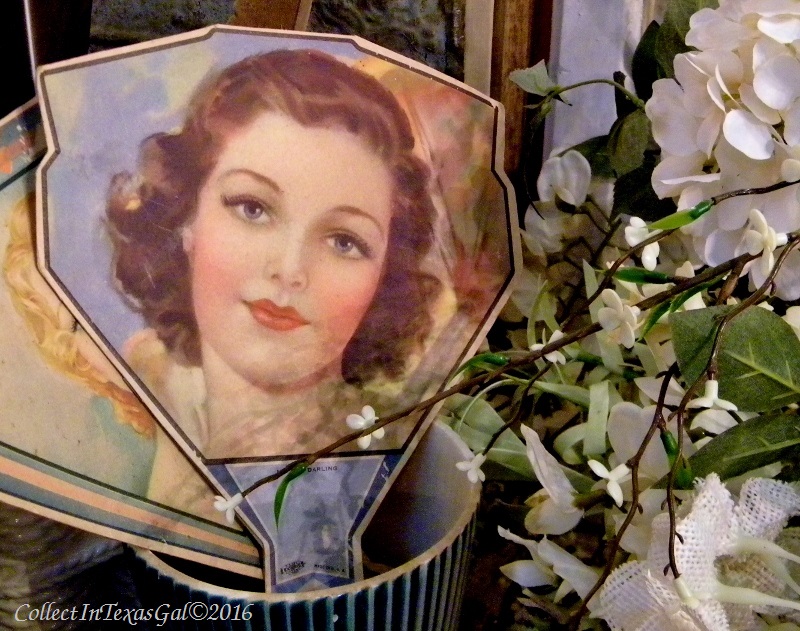
Fan of 'FANS' and A Family Fannie

Getting in the groove of February blogging has been anything but 'groovy'.  After hearts, flowers and this years short calendar day count, everything else about February sort of faded away as far as my interest. 

When that happens, I start taking count of my collections.  This serves a dual purpose as I ponder how to work them into the 2016 AtoZ April Challenge and a post for February.  So, let's see where a small collection of 'Hand Held Fans' takes us.

The first 'Fan' in my collection is very special and came from far, far away VietNam.  I will save that fan photo and story for the AtoZ Challenge.  It has possibilities of fitting into several letters other than the Letter 'F'.  I'll be working on that idea and theme for what will be my 5th year to participate.

The origin of 'Hand Held Fans' can be traced back 4,000 years to Egypt where it was a sacred instrument of religious ceremonies and a symbol of power.  Other ancient civilizations used fans in various forms as scribed in Greek and Roman texts as well as the Bible.  The folding hand fan was a creation of the oriental country of Japan where it was thought to be modeled after the folding wings of a bat.  The folding hand held fan made it's way to Europe in the 1500s by way of trade routes and quickly became an exotic and stylish symbol of wealth and class.
In America, fans had a humble beginning, were a necessary utilitarian implement, and a way of life for women who made and mended them for a living.  Shaker fans were made from woven straw or paper and by the mid 1800's were a viable manufactured product.  Vintage fans are highly collectible in a multitude of categories from advertising to Victorian Needlework Embellished fans with mother of pearl inlaid blades.
 
As is my usual way of delving into a collection/topic...one thing leads to another.  In the case of  'Fan'...it lead to Fannie. 

The name Fannie means Free, and is often short for Francis.  People with this name have a deep inner desire for a stable, loving family.  Fannie fit that character trait to a 'T' as a wife for 70 years and mother of seven children.

Fannie was my 1st cousin 2x removed.  Her father and my great grandfather were brothers who came to Texas together from Georgia.  She was born on April 1, 1878, in Arkansas and was raised in Texas.

Fannie was the fourth of six children...all girls with interesting Southern names...Texannah, Mary Jo,  Sallie Savannah, Susanna, and Ann Charlie.  The descendants of Fannie and her sisters are active members of Ancestry.com and have shared a wealth of our family history and many photos like this one of Fannie.  Fannie lived a long life of 89 years.  She died in May, 1967...8 months after her husband of 70 years.

Girls/women with the name Fannie tend to be orderly and dedicated to building their lives on a solid foundation of order and service.  They value truth, justice, and discipline.  I'd say my cousin Fannie certainly lived up to her name.
 I wonder if she had a collection of hand held fans.
I wonder if  this photo once had a handle!